

Floating platforms
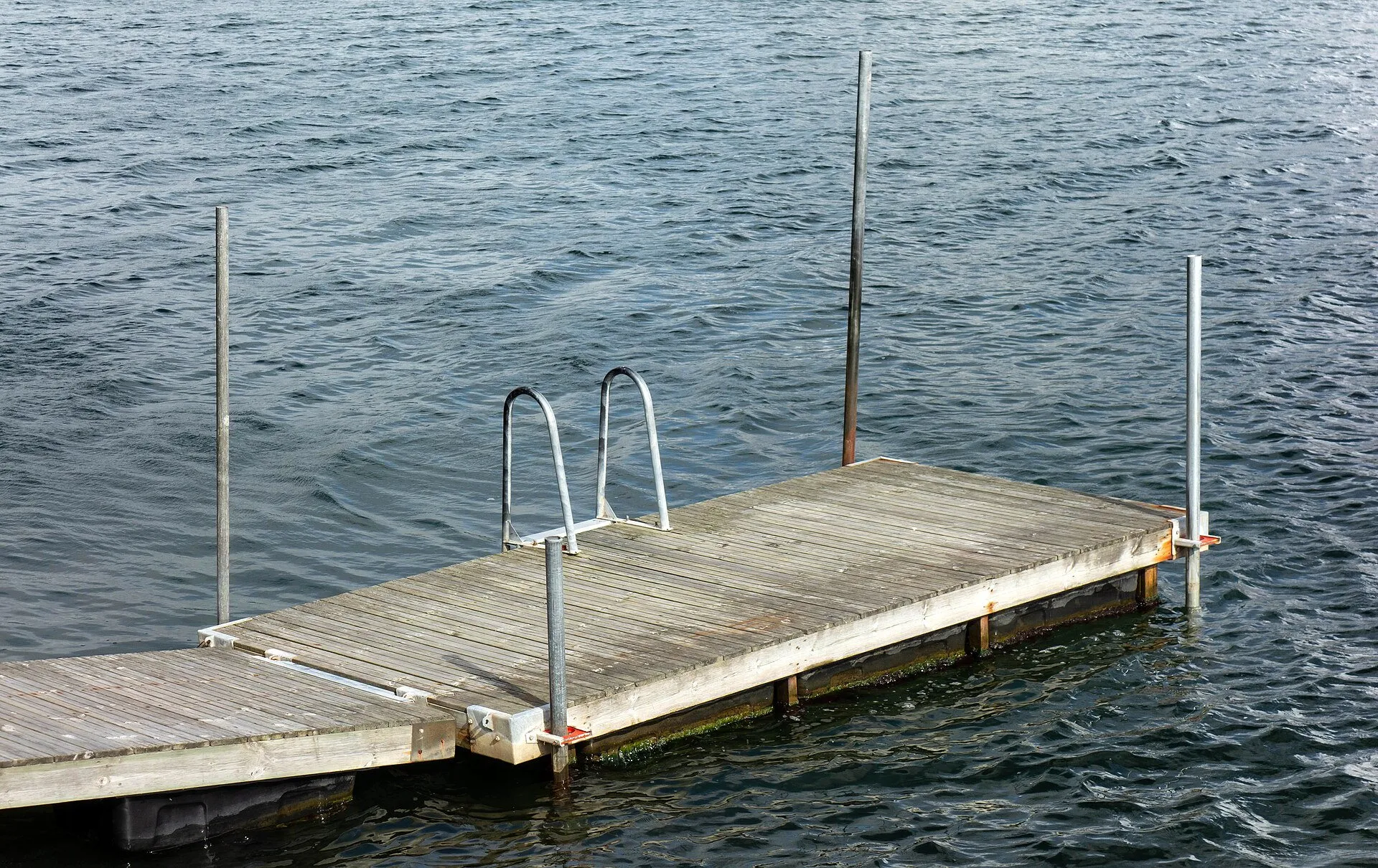
A buoyant deck held in position by guide piles, free to rise and fall with the tide. The freeboard — the step from deck to water — stays constant whatever the tide is doing, which is the entire point.
Service
A deck that rides the tide instead of fighting it.
In short
A floating dock sits on buoyant modules and rises and falls with the water, so the distance from deck to waterline never changes. In a region with several feet of tidal swing that makes boarding a small boat, a kayak or a paddleboard dramatically easier than from a fixed structure.
In detail
A buoyant deck held in position by guide piles, free to rise and fall with the tide. The freeboard — the step from deck to water — stays constant whatever the tide is doing, which is the entire point.
Interlocking float modules allow a platform to be configured, extended or reconfigured without rebuilding. They suit sites where the eventual use is still evolving or where seasonal reconfiguration is useful.
Purpose-built launch sections with a low side, guide rails and grab bars so a paddler can get in and out from a seated position. This is one of the most requested additions on creek and marsh-front properties.
The connection between the fixed structure and the floating one has to accommodate the full tidal range safely. Gangway length and hinge detailing determine how steep the walk is at low tide, and getting that wrong makes the whole system unpleasant to use.
Floats are held laterally by piles driven through or alongside them. Pile height must clear the highest expected water, and the rollers or brackets that run on them are wearing parts that need to be correctly specified for salt water.
Multi-slip floating systems, transient dockage and access platforms for marinas, clubs and community waterfronts, specified for higher traffic and duty cycles.
Northeast Florida has meaningful tidal range. On a fixed dock, that means the step from deck to boat changes by several feet across the day. At high tide you step down comfortably. At low tide you are climbing.
A floating dock removes that variable entirely. The deck sits at a fixed height above the water because it is floating on it. For anyone loading a kayak, helping a child or an older relative aboard, or getting into a small boat with gear in both hands, the difference is not a refinement — it is the difference between using the water and not bothering.
Floats are at their best in sheltered water: tidal creeks, marsh edges, canals and protected coves. They suit small craft, swimming access, and boarding from a seated position.
Fixed structures remain the better answer where you need to carry concentrated load — a boat lift, a roof, a crowd — or where the site takes constant wake from a nearby channel. Floats in exposed water move, and movement is wear.
The combination is frequently the right answer and is what we build most often: a fixed walkway carrying you out across the shallows to water that stays deep at low tide, with a floating platform attached at the end for everything that benefits from a constant waterline.
The connection between the fixed structure and the float carries the entire tidal range, and its length determines the slope you walk at the bottom of the tide.
A gangway that is pleasant at mid-tide and steep at low tide is a design that stopped halfway. The right length is calculated from the actual range at your site and the maximum acceptable slope, not from what fits neatly. It is a longer piece of aluminium or timber than most people expect, and it is not the place to save money.
The float is held in place laterally by piles. Those piles have to be tall enough that the float stays captured at the highest water the site can reasonably see — including surge. If water rises above the top of a guide pile, the float floats off it, and then it is loose in the waterway.
Guide pile height is consequently the single most consequential number in a floating dock specification in a hurricane region, and it is worth more attention than the deck material.
How it runs
We establish the tidal range at your site, how much wake and current the float will see, and how deep the water stays at the lowest tides.
Float type, deck material, module layout, gangway length and guide pile arrangement chosen for those conditions.
Designing the transition so it is safe and comfortable across the full tidal range, not just at mid-tide.
Guide piles driven, floats assembled and set, gangway hung, hardware fitted and the whole system checked through a tide cycle.
Before you decide
Getting these right at the planning stage costs nothing. Getting them wrong is expensive to undo.
Answers
Neither is better in general — they solve different problems. A fixed dock is more rigid, carries more concentrated load, supports a lift or a roof, and is unaffected by wake. A floating dock keeps a constant step down to the water across the whole tidal range, which makes it far easier to board small craft. Many of the best installations here use both — a fixed walkway reaching out to usable water, with a float attached for kayaks, paddleboards and dinghies.
Floating systems are generally designed so the floats rise on their guide piles with the surge. The failure mode to design against is water rising above the top of the guide piles, at which point the float can come off entirely. Guide pile height is therefore one of the most important specification decisions, and it is set against expected high-water conditions for the site.
The deck surface is maintained like any other dock. The specific items are the float units themselves, the hardware connecting modules, and the rollers or brackets that run on the guide piles. Those contact points wear and are the main inspection item. Growth accumulates on the underside of floats in this water and affects buoyancy over time.
Usually, yes. A launch section can often be attached to the end or side of an existing fixed dock, held by its own guide piles. The practical constraints are water depth at the attachment point and whether the existing structure gives a sensible place to make the connection.
Yes, in most cases. Floating structures and the piles that hold them are reviewed much like fixed docks, and the review considers footprint, location and what is on the bottom beneath them. Requirements vary by waterway and parcel.
Once permitted, a residential floating platform is typically a short installation — often several days to a week on site, depending on how many guide piles are needed and how accessible the location is.
Next step
We will come back with a clear scope and an honest view of what your site can support.
Keep exploring
Fixed docks engineered for tidal water, built to last on your shoreline.
ViewKeep the hull out of the water and the maintenance bill down with it.
ViewDockage that handles traffic, duty cycles and the people who inspect it.
ViewFix what is failing before it takes the rest of the structure with it.
View