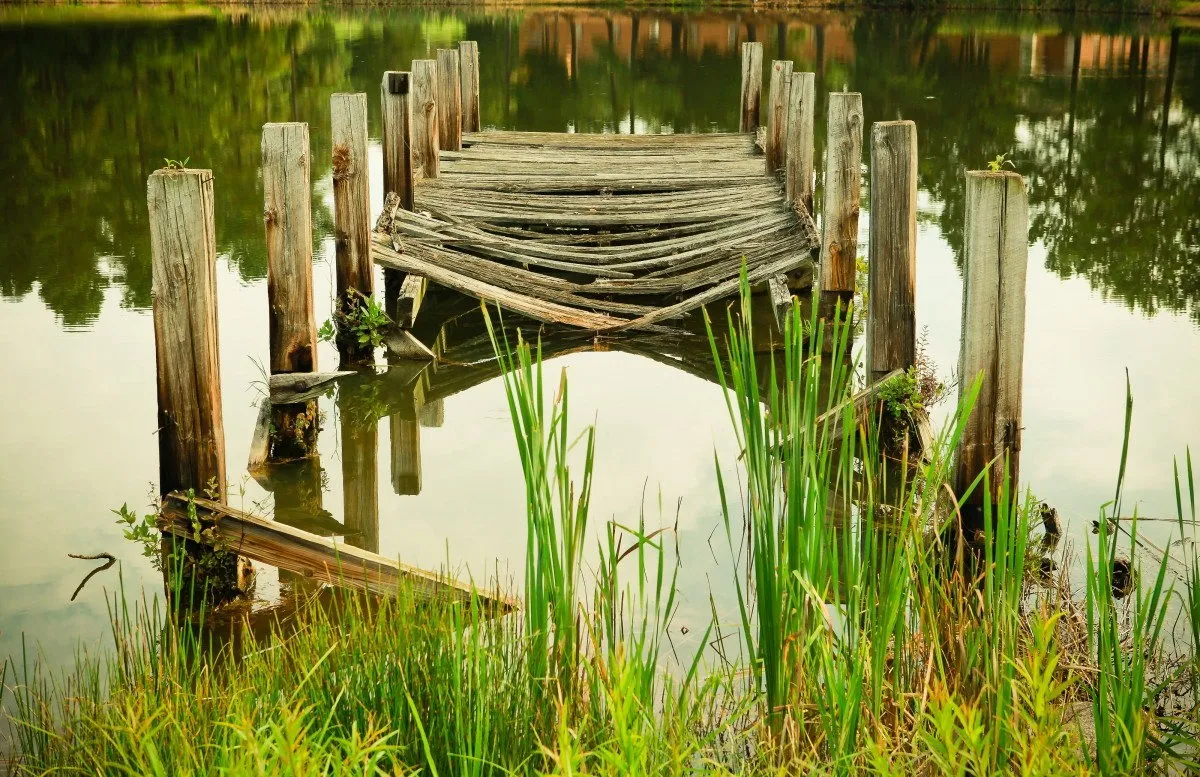
Weathered timber dock pilings and framing standing in shallow water beside marsh grass

Service

Dock Repair in Jacksonville & Northeast Florida

Fix what is failing before it takes the rest of the structure with it.

In short

Dock repair restores a structure that is fundamentally sound but has lost pieces to age, water or weather. The work ranges from replacing a run of soft deck boards to pulling and resetting pilings that have lost their grip in the bottom.

What we repair

  • Dock decking repairs
  • Structural repairs
  • Damaged piling replacement
  • Dock board replacement
  • Loose connections
  • Storm damage repairs
  • Railing repairs
  • Dock restoration
  • Dock safety assessments

In detail

How we approach this work

01

Decking and board replacement

Soft, cupped, cracked or splintering boards are the most common reason owners call. Individual boards can usually be swapped without touching the frame, provided the joists beneath them are still sound — which is the first thing we check.

02

Structural and framing repairs

Stringers, joists and headers fail from the top down where water sits in a joint, and from the bottom up where borers get in. Replacing a rotten framing member early is routine work. Leaving it is how a deck board failure becomes a section collapse.

03

Piling replacement

Pilings fail by rotting at the waterline, by being eaten below it, or by losing their embedment after scour or a storm. Replacing one means driving a new pile alongside, transferring the load and cutting the old one out — not bolting a splint to a bad pile.

04

Loose and corroded connections

Hardware is what holds a dock together, and salt air eats anything that is not properly rated. Bolts back out, brackets corrode, nails work loose with the tide. Re-fastening with correctly specified galvanised or stainless hardware is some of the highest-value repair work there is.

05

Storm damage

After a named storm we see displaced decking, sheared pilings, racked framing and docks that moved as a unit. We assess what is salvageable, document what is not, and get you a scope you can take to your insurer.

06

Railings, stairs and safety items

Loose railings, missing balusters, worn stair treads and failed ladder brackets are small jobs with outsized consequences. They are also the items most likely to be flagged in a pre-purchase inspection.

Start underneath, not on top

Nearly every dock repair call starts the same way: a board has gone soft, or the whole walkway feels springy. The temptation is to pull the bad boards, put new ones down and move on. On a structure in brackish tidal water that is often the wrong move, because the decking is rarely the first thing to fail.

Pressure-treated decking sits in the sun, dries out between tides and is replaceable in minutes. The joists under it stay damp, sit closer to the splash zone and hold water in every joint and fastener hole. Marine borers work from inside the timber outward, so a joist can be structurally finished while still looking solid from three feet away. The useful inspection is the one done from below, at low tide, with something to probe with.

What fails, and in what order

Fasteners go first. Salt air and wet-dry cycling attack hardware harder than timber. Under-specified nails and bolts loosen, corrode and lose their hold. A dock that creaks and moves under foot is frequently a hardware problem rather than a timber problem.

Framing goes next, usually at connections — where a joist meets a stringer, where a stringer is bolted to a pile, anywhere water can sit.

Pilings last the longest but fail the most expensively. A pile rots at the waterline, is eaten below it, or loses embedment when the bottom scours out around it. Replacing one is real work: a new pile driven alongside, load transferred across, the old one cut out and removed.

Decking is usually the symptom, not the disease.

After a storm

Northeast Florida gets storm surge, and surge does particular things to docks. It lifts decking off the frame from underneath, because the water pushes up before it pushes sideways. It racks framing out of square. It scours the bottom around pilings and reduces their grip without anything looking wrong from the bank.

If your dock has been through a surge event, the things worth checking are whether the decking is still fastened down at every point, whether the structure is still square, whether any pile now stands at a slightly different angle, and whether the bottom around the pilings is noticeably deeper than it was. A dock can look entirely normal and have lost a meaningful share of its capacity.

When we will tell you not to repair

We would rather turn down a repair than take money for work that will not last. If the pilings have gone, if more than about a third of the framing needs replacing, or if the structure has moved as a whole, repair money is being spent on a foundation that cannot support it. In that case the honest recommendation is dock replacement, and we will show you the arithmetic rather than just assert it.

How it runs

What working with us looks like

  1. 1

    Inspection

    We go over the structure from the bank out — decking, framing, pilings, hardware and any attached lift or roof — and separate what is failing now from what will need attention in a few years.

  2. 2

    Honest triage

    You get a plain assessment of whether repair makes sense. Where a structure is far enough gone that repair money would be better spent on replacement, we will tell you that rather than take the work.

  3. 3

    Scoped quote

    A written scope that names the specific members, boards, pilings and hardware involved, so you can see exactly what you are paying for.

  4. 4

    Repair

    Most repairs are completed in a single visit. Piling work takes longer because it needs driving equipment and water access.

Before you decide

Questions worth answering first

Getting these right at the planning stage costs nothing. Getting them wrong is expensive to undo.

Is the frame sound under the boards?
Replacing deck boards over compromised joists buys you a short reprieve and hides the real problem. Any honest repair starts underneath.
How old is the hardware?
A dock built with under-specified fasteners will keep failing at the connections no matter how much good timber goes into it. Sometimes the right repair is re-fastening the whole structure.
Has the bottom moved?
Scour around pilings, especially after a storm, reduces embedment without anything looking visibly wrong above water. A dock that has started to feel springy or that leans slightly is telling you something.
Are you fixing it or deferring a decision?
There is a point where accumulated repairs exceed what a replacement would have cost. We will show you where your structure sits on that curve.

Answers

Dock Repair — common questions

How do I know whether my dock needs repair or replacement?

The rough test is what proportion of the structure is still doing its job. If the pilings are sound and well embedded and the framing is largely intact, repair is almost always the better value. If multiple pilings are failing, the frame is soft in several places, or the structure has shifted as a whole, you are usually paying twice by repairing. We give you that assessment in writing before any work starts.

How much does dock repair cost in Jacksonville?

It depends entirely on what is failing. Replacing a run of deck boards is a modest job. Replacing pilings requires driving equipment and barge or bank access, and is a different order of cost. The only honest answer comes after someone has looked at the structure, which is why the inspection comes first.

Can you repair storm damage for an insurance claim?

We can inspect the structure, document the damage and give you a detailed written scope and estimate that itemises the work. What your policy covers is between you and your insurer, and we do not advise on coverage — but a clear, specific scope is what makes a claim straightforward.

My deck boards feel soft but look fine. What is happening?

Softness underfoot usually means the joist beneath has lost strength, not the board on top. In brackish water that is often borer damage, which works from the inside out and leaves the surface looking intact. It needs looking at from below.

Do you repair docks you did not build?

Yes. Most of the repair work we do is on structures built by someone else, sometimes decades ago. We assess what is there on its merits.

How long will a repaired dock last?

That depends on what was repaired and what was left. Replacing failing members in an otherwise sound structure can add many years. Replacing deck boards on a frame that is itself near the end of its life adds very little. We will tell you which situation you are in.

Next step

Request a dock repair estimate

We will come back with a clear scope and an honest view of what your site can support.

Prefer to talk(904) 821-5744

The more detail you give, the more accurate the first conversation will be.

Add measurements, budget, timing or photos
Preferred contact method
Photos of the site or existing structure

Up to three images or a PDF survey, 8 MB total. A shot of the shoreline and one of any existing structure help more than anything else you can send.

Or call (904) 821-5744

By sending this form you agree to be contacted about your project. Your details go to one marine contractor — they are never sold or shared with a lead network. See ourprivacy policy.